Tuesday, April 9, 2013

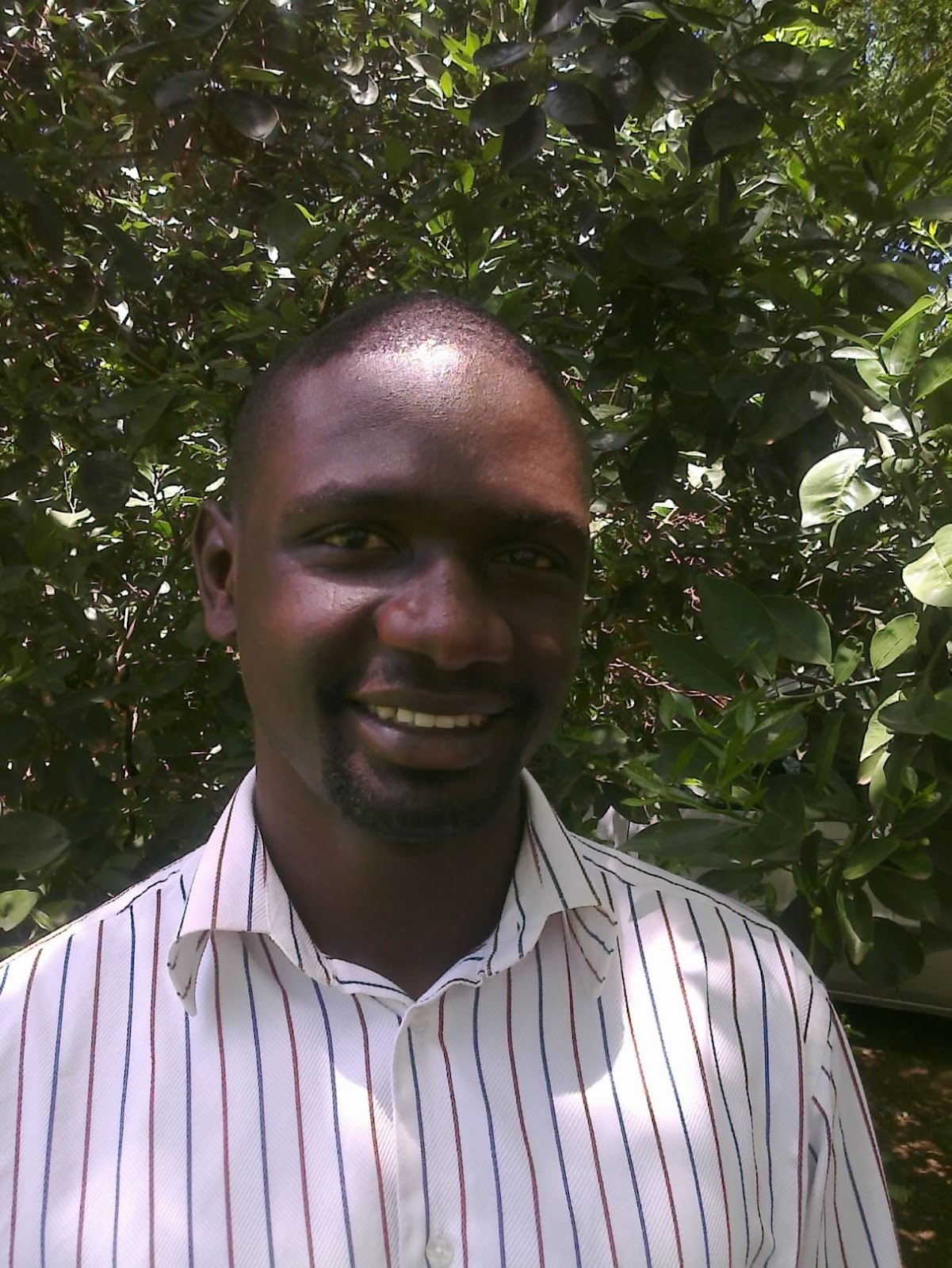
Stop Malaria Project Interview: Ruth Enyimu


As part of BAMM (Blog About Malaria Month) I will be featuring brief interviews with my coworkers at Stop Malaria Project (SMP) and Malaria Consortium (MC) in the Soroti office.
Note: SMP is implemented by MC, which provides technical assistance to the project.

Ruth Enyimu is a behavior change communication assistant at SMP.
  
A: Where are you from?

R: I’m from Kaberamaido.

A: What did you study?
R: My first paper was a diploma in secondary education. My bachelor’s degree is in adult and community education from Kyambogo University in Kampala.  I am now going for my master’s degree at Mukono Christian University in public health.  

A: Where have you worked before SMP/MC?
R: I first worked with World Vision in the children’s department where we looked at the beneficiary child, its family, health and education.   I worked there for about four months as a volunteer.  My second job was with Save the Children. I was supposed to work in Sudan in a rebel camp.  After the training, I remained working online.  But when the time came to go to Sudan, the rebels went to Central Republic of Africa.  I held my appointment for about 5 months, and then went to AMREF (African Medical and Research Foundation).  There, I was a project assistant for Malaria, HIV/AIDS and Water and Sanitation.

A: Why did you want to work for SMP/MC?
R: The project I was working for in AMREF came to an end.  One thing that excited me about SMP was that I already had experience.  It’s all about behavior change, not just treatment. That’s why I applied for that position.  I felt like if the community takes on the responsibility of prevention, there’ll be no cases in the facility.  I wanted to continue the work I had started with AMREF to work with VHTs (Village Health Teams). This was an opportunity to create sustainability for both projects.      

A: What drew you to work in public health?
R:  Most of the health issues are preventable diseases.  But they are ignored; people don’t have knowledge.  I believe public health will give me a lot of insight into community health.  I believe that will really help me change the lives of the community; but with their help, I can’t do it alone.  Generally, I don’t like to be office-based.  I really want to be deep down with the local person who has a problem.  Public health will directly take me there.  

A: What do you like most about your job?
R:  It really makes interact with the local person.  I get to interact with different people. Without SMP I wouldn’t have met you.  I’ve got to meet and train many Peace Corps Volunteers.

A: What do you think is the biggest challenge in malaria eradication?
R: It’s the attitude of people and the allocation of resources.  There are more resources for treatment instead of believing that prevention can succeed. There is also a knowledge gap of the local person.   

A: What do you think could be improved in the malaria eradication campaign?
R: The sensitization that we are doing is broad; we think the same sensitization will work in every region. It should be zeroed in what the community needs.  For example, if I was in charge of nets, very few would be allocated to regions where the burden isn’t high.  Areas with a high burden should be focused on.  Small community and village groups like SACCOs (Savings and Credit Co-operatives) should be taught the benefits of health and changes will occur.  Most of our sensitization is radio based and not every person will interpret what they hear on the radio.  Our IEC (Information Education Communication) materials for each region (holds up a poster) should show have real photograph of an actual family in the community that everyone knows.  These are just cartoons.  But with a real photograph, people would think “even I could do this.”  The health education in the facilities should focus on individuals or households, and should be followed up.  No one bothers to make follow- ups to see what the problem is from the grassroots. Instead, they wait until they go to the facility.  Like other outreaches are done, with immunization and TB programs, why not do outreaches for malaria treatment and testing?  

A: After SMP ends, what would you like to do?
R: I would really still wish to work with another organization that is handling malaria issues.  It’s a big burden for the country.  

A: Can you share a memorable experience from working at SMP?
R:  We had a radio talk show which I initiated brining a local person, a couple who went for IPTP (Intermittent Preventive Treatment in Pregnancy) for four doses, and got treatment within 24 hours.  I realized that was very educational, but very brief.  When you bring in a local person, you get many callers, and educate others on the real experience.  Another morning, I decided to listen to the radio.  One of the LC3 (local councilor) from Kaberamaido discussed how people were using (bed) nets for fishing.  So, I got the driver and decided to go up there.  I saw nets in the swamp used for fishing.  I fear water, so I couldn’t remove them.  And I knew that if I removed them, it wouldn’t help.  So I got the community together and asked them to be sincere and march to the water to remove it.  I said, “Let’s go and remove them and we’ll talk.”  The only one that remained was because the owner isn’t there, but he refuses.  I said, “this one doesn’t have an owner, he doesn’t want to use it, and doesn’t think it’s important”.  We removed it, and had a meeting and gave them proper education on net use.  I asked them “how much does this fish cost?”  A kilo of the tiny fish was 2000.  “How much do you spend on treating malaria in your household?” They said at least 20,000.  I told them “let’s put this in a weighing scale”.  I used a stone to represent the cost of treatment and the other side was sleeping under a net.  We agreed that we should all we be watchmen, and signed an agreement that if someone uses a net for fishing, they would be arrested.  And today, there is no fishing with (bed) nets.   They realized that if you misuse something you are given for free, then you lose it. 

Stop Malaria Project Uganda is one of many organizations that host a Peace Corps Volunteer in partnership with the Stomping Out Malaria Initiative in Africa. The initiative mobilizes and connects over 3,000 Peace Corps Volunteers in 23 countries in sub-Saharan Africa to work together to eradicate malaria from the continent. To learn more, please visit: http://stompoutmalaria.org/.     


Monday, April 8, 2013

Stop Malaria Project Interview: Benjamin Omagor


As part of BAMM (Blog About Malaria Month) I will be featuring brief interviews with my coworkers at Stop Malaria Project (SMP) and Malaria Consortium (MC) in the Soroti office.
Note: SMP is implemented by MC, which provides technical assistance to the project.
 
Benjamin Omagor is a technical assistant employed by MC to work in SMP. 

  
A: Where are you from?
B: I’m from Soroti, in Arapai subcounty, Onyakai village.

A: What did you study?
B: I received a diploma in clinical medicine and community health from Mbale School of Clinical Officers. Right now I’m studying for a bachelor of science in health services management at Islamic University in Uganda in Mbale.  Afterwards, I will pursue a master’s degree in health economics or public health.  If all goes well, I’d like to do it at Johns Hopkins University, or study in London. 

A: Where have you worked before SMP/MC?
B: I was working as a clinician at Louis Memorial Medical Center in Kampala.  I was also working as a buffer trainer for Malaria Consortium in a project called ICCM (integrated community case management) which involves treatment of malaria, pneumonia, and diarrhea at the household level implemented by VHTs (village health teams).  Working those two jobs gave me a clear understanding of the difference of health service delivery between the elites and the rural poor.  

A: Why did you want to work for SMP/MC?
B: I have this enthusiasm to implement community based projects.  I realized that I could be of use based on the experience that I gained from working in a well-facilitated health facility.  Now during supervision, I see myself trying to create an improvement in rural facilities.  The job also brought me back home.  Since the facility I was working in had patients with health insurance, I began to think “is it possible for me to come up with an insurance package for the rural poor?” Coming back to Soroti made it easy for me to think how I can implement that, even though it’s still just an idea.  Slowly, I’m starting to see how I can kick-start that project.  The point is to help people that are really poor.  I’m also involved with a chicken project to help generate income for poor households.      

A: What drew you to work in public health?
B:  As a clinician, I was seeing people come with different illnesses to a facility. The fact that there is a possibility to prevent a disease drew me to public health.  Why does someone have to wait until they are sick to come a facility?  We can attack malaria from all fronts, from prevention to management.  It’s all connected.  The fact that I can work with communities and crowds also drew me in. 

A: What do you like most about your job?
B I’m really involved deep inside the fight against malaria.  It helps me also move to places, meet different people and study different aspects about human beings. 

A: What do you think is the biggest challenge in malaria eradication?
B: The biggest challenge right now is the eradication of the mosquito itself. We are now encouraging people to use barrier methods, like sleeping under nets.  In our environment, it is almost impossible to eradicate the mosquito with so many swamps, especially here in Teso, with all the fingers of Kyogo Lake.  You can’t drain the swamps and a mosquito can fly over two kilometers.  But we have gained a lot success in preventing deaths from malaria.   

A: What do you think could be improved in the malaria eradication campaign?
B: I think we need to take curative measures nearer to the communities.  More research should be done on sterilizing mosquitoes.  If you can’t do without the mosquitoes, at least stop it from carrying the parasite and transmitting malaria. Introducing scaling up of ICCM should also be done. Drugs should always be available and recruit enough health workers to treat children with malaria. Drugs are useless in the facility if no one can dispense them.

A: After SMP ends, what would you like to do?
B: I would like to work with health projects for about five years.  But, if it doesn’t come my way, I will do poultry or other business.  Or I could volunteer in rural health facilities as a clinician.  And of course, I want to pursue my master’s. 

A: Can you share a memorable experience from working at SMP?
B: When I did clinical audits in Ngora hospital, we discovered they didn’t have an emergency room in their OPD, or Outpatient Department. (Clinical audits are a way for health professionals to be assessed through clinical performance.  It involves setting standards, and the audits compare the reality to the standards.  It identifies gaps that need to be addressed.)   So, for the first time, I saw that the administrators took it seriously.  Before I left, they identified a room to be set up for the emergency room.  It impressed me that they took it very seriously.

Stop Malaria Project Uganda is one of many organizations that host a Peace Corps Volunteer in partnership with Stomping Out Malaria in Africa. The initiative mobilizes and connects over 3,000 Peace Corps Volunteers in 23 countries in sub-Saharan Africa to work together to eradicate malaria from the continent. To learn more, please visit: http://stompoutmalaria.org/.     


Photo of Fred (from last interview)


Friday, April 5, 2013

Stop Malaria Project Interview: Fred Akol


As part of BAMM (Blog About Malaria Month) I will be featuring brief interviews with my coworkers at Stop Malaria Project (SMP) and Malaria Consortium (MC) in the Soroti office. Photos to come later!

Fred Akol

A: Where are you from?
F: Soroti District

A: What did you study?
F: Social Sciences for Bachelors’ degree, Public Health for Master’s degree, and a diploma in Project Planning and Management.

A: Where have you worked before SMP/MC?
F: AMREF (African Medical and Research Foundation) as a project officer for HIV/AIDS, TB, and Malaria. Before that, the Landmine Awareness Trust in Soroti.

A: Why did you want to work for SMP/MC?
F: I saw the activities for fighting malaria which is the main killer disease for the region and country.  Secondly, it takes me deep in the community. 

A: What drew you to work in public health?
F: I love working with communities and health is a big issue in communities.  People need to be supported on issues of health and public health. I like the practical work, being active within communities, and being able to interact with real people.

A: What do you like most about your job?
F: Exposure to different stakeholders in different offices and being open to learning on the job.

A: What do you think is the biggest challenge in malaria eradication?
F: People’s attitudes towards prevention methods.

A: What do you think could be improved in the malaria eradication campaign?
F: Methods for prevention; promote IRS- it's expensive, but it’s the best.

A: After SMP ends, what would you like to do?
F: I will still work with public health partners which are still in health field because I feel I need to do much of the same thing.

Thursday, April 4, 2013

The Real Malaria


Last night I was watching a clip of the documentary about the book Guns, Germs, and Steel, which follows the author, Jared Diamond, around the world in his quest to discover how such huge inequalities emerged between the developing and the developed world. In other words, why are some countries so rich and others so poor?  While in Zambia, one of the poorest countries in the world, with an average life expectancy of 35, he visited a hospital and talked to a health worker about the burden of malaria there.  Dozens of children were lying in beds in one ward, one of which barely had her eyes open, unblinking.  Then, the camera panned to Mr. Diamond, who had to cover his face because he started crying.  He said, “There’s a difference between understanding something intellectually and experiencing it firsthand.” I immediately teared up, not just from seeing this older, world-renowned author becoming so upset about a problem that is so far removed from most of us, but also because I had an almost identical experience about six weeks ago. 

In late February, I spent a few days in neighboring Amuria district to help out with Integrated Support Supervision (ISS).  During ISS, we visit a range of health facilities to get data related to malaria.  On our second day, we visited St. Clare Health Center III.  In Uganda, there are four levels of health facilities, with one being the lowest, according to size and services offered.  Although St. Clare was a level III health center, it operated like a level IV, according to Ann, a local nurse, who was helping us with ISS.  St. Clare is a private hospital funded by the Catholic Church, and has a few mzungus or foreigners working there. Amuria is less developed than Soroti, and here “in the middle of nowhere” (not my words, but those of our driver, Ronald) on a small hill was a pretty impressive facility on a beautiful campus.  Besides the hospital, church, and school, there weren’t even huts around this area.  It was nothing but trees and scrubby bushes as far as the eye could see.  

My part of the ISS was to get data from the Antenatal Clinic (ANC).  To get to the ANC, I had to pass through the children’s ward.  As I was waiting in the hall outside the ANC office, Ann came in telling one of the nurses that a child had a very high fever and needed immediate attention.  I could see several people huddled around one of the beds.  Curiosity got the better of me, and I went over to see what was happening.   

It was a four year-old girl who was naked, with her eyes closed, arms bent and fists clenched near her face. She kept making an involuntary whimpering sound over and over.  This sound still haunts me.  Ann said that her malaria test result was a 3+, which means she had an extremely high density of malaria parasites in her blood.  This, combined with a fever of 104 and convulsions, led to a diagnosis of severe malaria.  Ann instructed the nurses to give her an I.V. (of what I can’t remember, but should know) to bring the down fever.  They also kept crushing up some pills and gently sprinkling it in her mouth.  Besides the fact that a little girl was in so much pain from a completely preventable disease in such an efficient hospital, so much seemed wrong; the colorful, cheerful paintings of biblical scenes on the walls, nets on every bed (which is rare in most health facilities), and the fact that I felt helpless and ashamed that I wasn’t doing enough.  All of this was just too much for me, and I had to leave the ward with tears in my eyes.  

It’s like Jared Diamond said, intellectual understanding can’t make you ready for first-hand experience. No matter how many case studies I read in grad school, days of training and workshops I’ve completed here, none of it could have emotionally prepared me for seeing malaria up close and personal.  When I came back later, Ann was still with the little girl.  Her fever had come down, and her body looked a little more relaxed.  I’m not very religious, but I believe in prayer.  So, I said a prayer for the girl and her family.  She was still alive when we left St. Clare later that afternoon and I can only hope and pray she is still alive today.     

To be honest, I can barely get through writing this without crying.  Look, I know there are countless sad stories out there about sick kids in Africa, but I still feel compelled to share mine.  We’ve all seen the stereotypical images on TV commercials or the news.  I’m not trying to be trite, pull at your heart strings or make you feel guilty.  But this problem is real.  It doesn’t go away when the commercial ends or after I leave Uganda.  It won’t go away without a lot of sacrifices of our time, efforts, and yes, money.   I know that my one year service here isn’t enough to make a huge impact and at times I should have taken a lot more initiative.   But, if by reading this story, you start paying more attention to malaria and hopefully help raise awareness about it (or development or global health) then at least I’ve made a small dent in this gargantuan epidemic.  You can start by sharing this blog entry with your friends, family, colleagues, or students.  Changing your cover or profile photo on facebook to one of our Stomping Out Malaria images (found on my facebook page) for the month of April is also a simple, easy step to help our movement gain momentum leading up to World Malaria Day on April 25th.  Thank you.

When I was a history major at Western Kentucky University, Jared Diamond’s book was discussed and lauded by several of my professors.  He actually came to speak at WKU, but for some reason, I didn’t go to his lecture and I’ve always regretted it.  Now that I’ve seen how emotionally invested he is in development, Guns, Germs, and Steel will quickly move up my reading list.  After all, he inspired me to finally share this experience.